BooStore vs OpenCart Comparison: Why Next-Gen SaaS Outperforms Classic CMS
Detailed engineering analysis of BooStore and OpenCart platforms. Vanilla JS advantages, total customization with HTML/JS access, critical load handling, and built-in SEO automation with no hidden costs.
📄 Table of Contents
1. Architectural Concept: Vanilla JS & JSON-Native vs jQuery Monolith
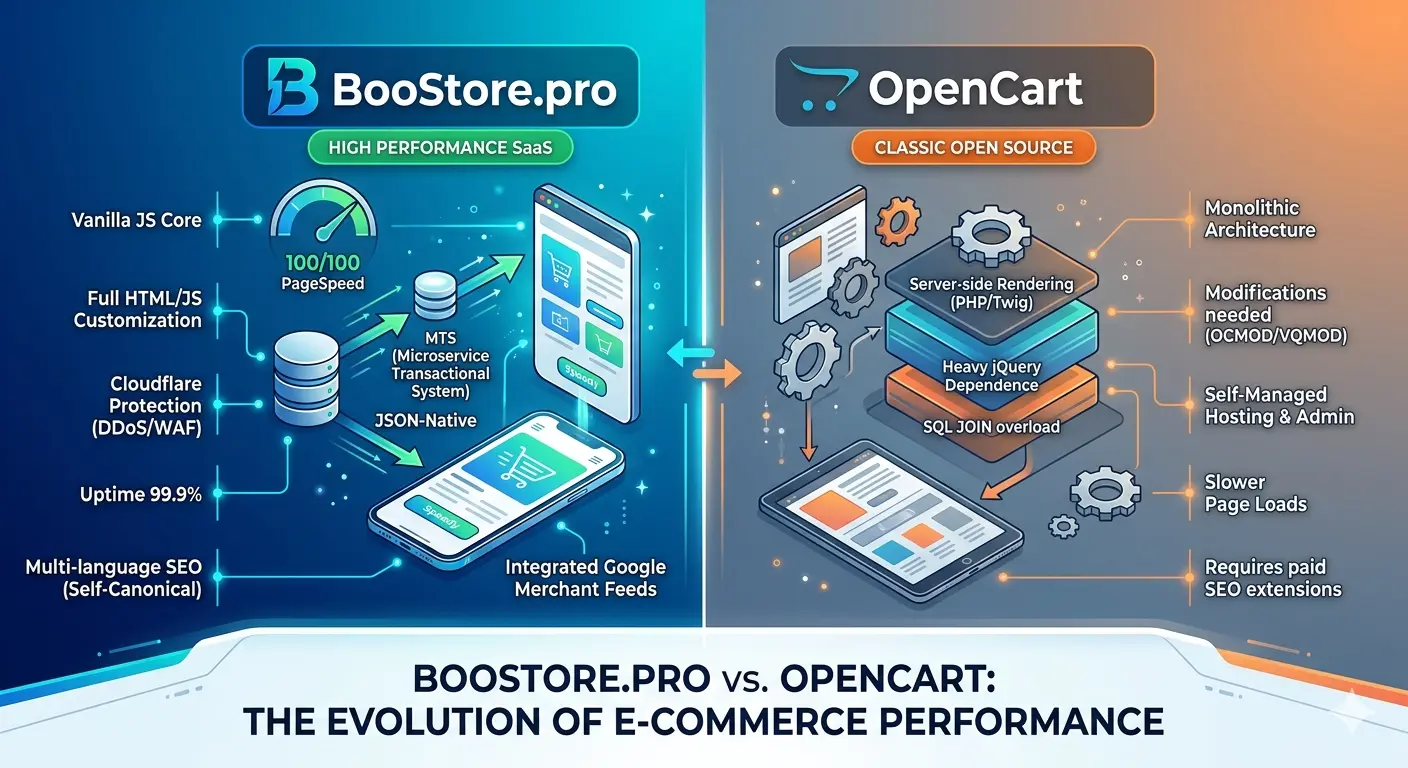
The main architectural problem with OpenCart (versions 3.x and 4.x) is its monolithic structure and outdated technology stack. Out of the box, OpenCart is heavily dependent on the jQuery library, heavy selector chains, and server-side HTML generation (Twig/PHP templating). As the product catalog and database grow, this creates a massive load on the hosting CPU and slows down page rendering in the user's browser.
BooStore is designed on a fundamentally different logic:
- Focus on Core Web Vitals and 100/100 PageSpeed: The platform completely abandoned heavy third-party libraries. All interactive functionality is written in pure Vanilla JavaScript. This minimizes page weight, eliminates main thread rendering blocking, and provides instant visual response on mobile devices.
- JSON-Native architecture: All key system components exchange data with the server asynchronously using raw JSON format. The platform documentation clearly defines the operation of these modules (Ajax loading of articles in JSON format, Ajax loading of categories, Ajax loading of product cards). The client browser receives only structured data and instantly assembles the interface on the fly, instead of downloading megabytes of redundant HTML code.
- Asynchronous processes: Adding to cart, submitting reviews, applying smart filters, and product list pagination all work on seamless asynchronous Ajax requests without reloading the entire page structure.
You can read more in our expert article: Ultra-Fast E-commerce Architecture.
2. Full Customization: Absolute Control Over Code and Metadata
There is a stereotype that SaaS platforms limit developer freedom, unlike OpenCart where there is direct access to source files. However, in OpenCart any attempt to implement custom HTML code, third-party scripts, or non-standard blocks turns into modifying template files through the OCMOD/Vqmod system, which breaks at the first engine update.
BooStore breaks these limitations by providing complete freedom of action:
- Direct access to HTML, CSS, and JavaScript: The platform gives developers and webmasters a legitimate tool for full customization. You can directly edit the HTML framework, connect your own custom style sheets (CSS), and implement any Vanilla JavaScript scripts to create a unique user experience (UX/UI).
- Creating custom blocks with your own metadata: You are not tied to a rigid template grid. In BooStore you can create independent arbitrary blocks in any part of the site, fill them with unique content, and — critically important for SEO — set your own metadata for these blocks. This allows you to create the most complex page structures for any business task.
- Customization isolation: All your custom widgets, styles, and scripts work independently of the core. They are correctly processed by the system and are not overwritten during global platform updates.
3. SEO and Content Automation: Bulk Import and Generation Out of the Box
In OpenCart, the basic content import and metatag management system requires manual configuration or purchasing third-party modules for working with databases (e.g., CSV Price Pro). Transferring the structure of categories, blog articles, or brands often turns into a complex technical task.
BooStore implements an end-to-end fast automation ecosystem:
- Universal instant import: The system allows you to instantly populate site structures. It supports both quick data import directly from the clipboard (copy-paste) and full synchronization via Excel files or Google Sheets. The merchant can mass-import not only product nomenclature but also manufacturers, collections, article catalog hierarchies, and blog text materials.
- Auto-substitution of descriptions by characteristics: The platform solves the problem of unique descriptions for thousands of product cards. The built-in algorithm can automatically generate and substitute text product descriptions, dynamically based on the specified technical characteristics (attributes) of a particular item. This radically accelerates the indexing of long-tail search queries without hiring copywriters.
- Quick catalog translation: Content localization for multilingual sites is automated, allowing you to instantly deploy full versions of the store in other languages without manually copying each line.
4. Full SEO Flexibility and Impeccable Multilingualism
Building the correct multilingual site structure on OpenCart often leads to "duplicate conflict". Incorrect canonical tag generation, confusion in language codes (e.g., using the non-standard prefix ua instead of uk), and broken SEO-friendly URLs require constant editing of configuration files (SeoPro, .htaccess) and manual control.
BooStore implements absolute SEO flexibility at the core level:
- Automatic Self-Canonical: The platform eliminates the risk of page merging by search robots. Each language version dynamically generates its own canonical tag pointing strictly to the current URL (self-canonical). Search engines see each language copy as an independent relevant page.
- Valid Hreflang and HTML Lang: The system strictly adheres to international language coding standards. For the English version, the correct ISO standard code —
hreflang="en"— is automatically served, ensuring proper geo-targeting in Google. Links between all alternative page versions and the technicalx-defaultparameter are set automatically. - Semantic URLs and Multilanding: The platform generates clean, human-readable URLs (filter micro-commands are translated into static landing pages). Product selection filters form unique meta tags (Title, Description, H1) for property combinations (e.g., "Brand 72V Electric Bikes"), creating thousands of ready-made landing pages for search traffic.
- Built-in Microdata: Valid semantic Schema.org markup (JSON-LD / Microdata) is integrated into the default page output code (
hotengine-markingmodule). Search engines immediately form rich snippets with prices, ratings, and product availability in search results.
Important SEO detail: All meta tags, HTML headings, canonical links, and alternative language chains are fully open for editing and flexible automatic configuration. You control the site structure without limitations or hardcoding.
5. Marketing, Exports and Google Merchant Center: No Extra Charges or Hidden Fees
Attempting to run Google Ads contextual advertising (including Performance Max campaigns) or export products to marketplaces from OpenCart inevitably runs into the need to purchase expensive feed modules (e.g., AnyFeed, YML/XML export). Any feed customization — adding custom labels, filtering products by availability, price, or margin — requires programmer services.
BooStore offers a ready-made marketing suite built into the subscription:
- Smart product feeds: Generation of up-to-date data exports happens automatically. The system creates valid XML/CSV feeds that are accepted without errors by Google Merchant Center and Facebook Commerce Manager moderation.
- Flexible labels and filters for advertising: In the control panel, you can in two clicks, without programmers and completely free of charge, distribute products into groups, set up special labels (custom_label_0-4), filter exports by manufacturers, categories, or price ranges. This allows you to instantly optimize advertising budgets by segmenting products in Performance Max.
- Flexible markup options: You can fully control pricing rules in exports (Google Merchant, Rozetka, Prom.ua, Epicentrk.ua): disable markups for individual platforms, use formula rules, or export the original price to increase offer competitiveness.
- Integration with CommerceAPI: Data exchange on sales, stock balances, and statistics (Sales Statistics) is transmitted via secure API in JSON/CSV formats. Order data is sent to CRM systems (KeyCRM, Zoho, etc.) on the fly at checkout.
- Built-in notification bots: The platform contains built-in gateways for instant notification via Telegram Bot and Viber Bot. Admin alerts about new orders and status changes work immediately, requiring no purchase of paid SMS gateways or external connectors.
6. Fault Tolerance, Security, and Massive Loads
For OpenCart, the critical limit is 20,000–30,000 products. Above this mark, the MySQL database starts to choke from the abundance of relationships, and the combined operation of the built-in filter and high traffic (from 1000 concurrent sessions) requires renting expensive dedicated servers and constant administration.
BooStore architecture is initially designed for enterprise loads:
- 99.9% Uptime and cloud infrastructure: The software suite is deployed on distributed servers with 99.9% uptime. The system includes automatic data backup and 24/7 availability monitoring. Your trading platform is protected from maintenance pauses.
- Network security and DDoS protection: Advanced Cloudflare protocols are deeply integrated into the platform. This ensures real IP address hiding, end-to-end SSL encryption, and WAF (Web Application Firewall) activation that blocks malicious bots, parsers, and SQL injection attempts at the edge. Two-factor authentication (2FA) via Google Authenticator is available for administrators.
- JSON indexation of filters: The "Search Filter and Product Type" module processes millions of attribute combinations without compromising speed. Stock recalculation and filtering are performed instantly due to lightweight JSON packet transfer, making it easy to sustain traffic during peak sale periods.
- Unlimited catalog growth: Thanks to deep optimization of indexes and data storage structures, the platform provides the ability for practically unlimited growth of product nomenclature volume.
7. Constant Evolution: Free Updates for Market Demands
The OpenCart architecture is static. The release of a new major engine version (e.g., moving from 3.0 to 4.0) essentially means rewriting the site from scratch: old templates are incompatible, purchased modules don't work, and the database requires complex migration with the risk of losing SEO positions.
BooStore infrastructure development:
As a modern SaaS platform, BooStore develops centrally. The platform regularly receives automatic and completely free core updates. All changes dictated by new Google algorithms, security requirements, changes in advertising system APIs, or web development trends are implemented seamlessly for all active stores. Businesses get an up-to-date, technically advanced tool without the cost of in-house developers and without the risk of disrupting stable site operation.
Comparative Infrastructure Analysis Under Peak Load
| Performance Parameter | OpenCart (3.x / 4.x) on Standard VPS | BooStore (Cloud Architecture) |
|---|---|---|
| Behavior with 50,000+ products | Significant SQL query slowdown, long server response (TTFB > 1.5 sec). | Stable TTFB < 0.2 sec thanks to caching and JSON architecture. |
| Multithreaded filtering | High risk of database crash (MySQL Max Connections) under peak traffic. | Instant Asynchronous data loading without creating heavy server queues. |
| Guaranteed Uptime | Depends on hosting and admin. Average 98.5% - 99.0% (failures due to logs and Cron can occur). | 99.9% Uptime 24/7 monitoring and automatic failover. |
| Out-of-box protection | None. Requires manual firewall setup, spam protection, and security modules. | Integrated Cloudflare WAF, DDoS protection, hidden IP, 2FA (Google Authenticator). |
Technical Feature Comparison Table
| Comparison Criterion | OpenCart + Modules | BooStore (Built-in Core) |
|---|---|---|
| Technology Foundation | Server-side rendering (Twig/PHP), heavy jQuery dependency. | Vanilla JS Lightweight clean code, JSON-Native asynchronous architecture. |
| Design Customization | Limited by Twig templates. Custom code often breaks extension architecture. | Total Full access to HTML, CSS, JavaScript. Create blocks with own metadata. |
| Page Load Speed (PageSpeed) | Requires expensive optimization, script compression, and caching. Mobile score rarely exceeds 60-70. | 100/100 Ideal Core Web Vitals for search robots by default. |
| Content Management | Manual entry. Import of categories, brands, and blog articles requires separate paid plugins. | Universal import from Excel, Google Sheets, or clipboard for all entity types + auto-description generation. |
| SEO and Multilingualism | Risk of page duplicates. Complex hreflang and canonical setup. Localization compatibility issues. | Automatic dynamic self-canonical for each version. Correct ISO code en for EN localization. |
| Google Merchant and Exports | Requires purchasing paid export modules. Feed label customization done manually via code. | Built-in smart feeds with flexible labels and filters. Full control of pricing rules for each platform. |
| Integrations and API | Limited REST API. Complex webhook and CRM synchronization setup. | CommerceAPI with JSON/CSV data transfer. Instant order submission to KeyCRM, Zoho, and others. |
| Security | Basic. Requires manual SSL, WAF, bot protection, and SQL injection prevention setup. | Cloudflare WAF, DDoS protection, IP hiding, 2FA (Google Authenticator) out of the box. |
| Updates | Major versions require complete site rework. Module and template incompatibility. | Automatic free core updates. Seamless change implementation without developer involvement. |
Economic and Technical Benefit
By choosing OpenCart, businesses buy a free core but fall into a trap of hidden costs: license fees for 20–30 modules, programmer fees to resolve code conflicts, and regular expenses for high-performance VPS hosting to compensate for server load from filters.
BooStore offers a ready-made ecosystem where all critical tools — from the ultra-fast Vanilla JS engine, total block customization (HTML/JS), and smart SEO automation to finely configurable ad feeds for Google Merchant and cloud protection — are already integrated into the platform, work seamlessly together, and are regularly updated to meet current search engine requirements without any additional payments.
❓ Frequently Asked Questions
Answers to popular questions about comparing BooStore and OpenCart.
How is BooStore different from OpenCart?
OpenCart is a classic open-source PHP/jQuery engine requiring self-managed hosting, module purchases, and ongoing maintenance. BooStore is a next-generation SaaS platform built on Vanilla JS with JSON-Native architecture, 100/100 PageSpeed out of the box, built-in ad feeds, SEO automation, and full HTML/CSS/JS access for total customization.
Can I migrate my site from OpenCart to BooStore?
Yes, we have a detailed migration guide: How to Migrate Your Online Store from OpenCart to BooStore.
How does BooStore compare to WordPress + WooCommerce?
We've prepared a detailed comparison on speed, security, and performance: WordPress/WooCommerce vs BooStore.
How much does it cost to rent a store on BooStore?
Details on pricing and the economic benefit of subscription instead of buying and maintaining your own engine: How Renting an Online Store Saves Money.
Where do I start creating an online store?
Use our 29-point checklist for launching an e-commerce project: E-commerce Launch Checklist.
What are the actual PageSpeed scores of BooStore?
The platform consistently achieves 100/100 Performance, 100/100 Accessibility, 100/100 Best Practices, and 100/100 SEO in Google PageSpeed Insights. This is achieved through pure Vanilla JS architecture, full caching without memcache, deferred script loading, and JSON-Native data exchange.
Is BooStore suitable for large catalogs?
Yes. The platform was initially designed to handle hundreds of thousands of products and millions of filter combinations without performance loss. Thanks to JSON indexing and asynchronous architecture, filtering and search work instantly even under peak loads.